Atlantic Football Fish - Himantolophidae
Atlantic football fish Himantolophidae are deep-sea anglerfish found in the Atlantic. Learn about their biology depth range and why they are not seen in Fuerteventura waters.
 Luisa
Luisa
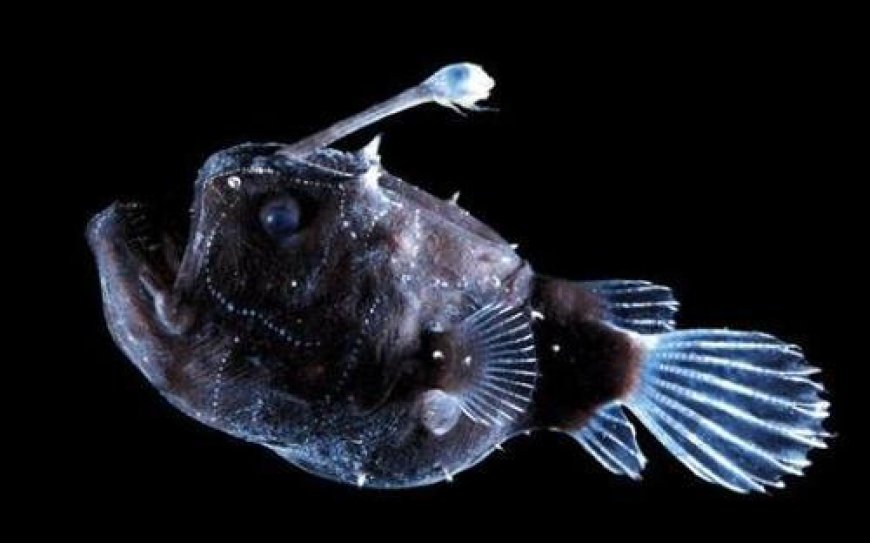
The Atlantic football fish belongs to the Himantolophidae family of deep-sea anglerfish, a group made up of around 22 known species. It is a deep ocean species associated with extreme depths, far beyond the reach of normal diving or snorkelling around Fuerteventura.
An Article by Hannah Mackay, local Scuba diving instructor, with The Voice Fuerteventura
Occasional specimens are sometimes recorded in wider Atlantic deep-sea surveys, but this is not a species you would ever encounter in coastal waters or typical marine observation around the islands.
The Atlantic Football fish belongs to the Himantolophidae family of the globose, deep-sea angler fishes, of which there are 22 species. They were first discovered in the early 1900’s by a deep-sea fisherman in search of flounders.
What do they look like?
Anglerfish are deep-sea fish that live in the darkest parts of the ocean, far beyond normal diving depth around the Canary Islands. They are not a species you will ever encounter in coastal waters around Fuerteventura unless brought up from extreme depths.
Males and females look very different, which is one of the most unusual aspects of the group. Males are extremely small, usually no more than a few centimetres in length, and have a soft, almost gelatinous appearance. Females are far larger and more solid in form, with some species reaching sizes of around 60 cm.
The female has a rounded, globose body shape and a large head with a wide, oblique mouth. The snout is short and blunt, giving them a distinctive profile. The skin becomes thicker in larger individuals and is reinforced with small bony structures known as bucklers, adding to their heavily armoured appearance.
Despite belonging to the same species group, the differences between male and female anglerfish are extreme, making them one of the most unusual examples of sexual dimorphism in marine life.
Where do they live / how do they hunt?
Anglerfish are equipped with a specialised adaptation above the eye known as the illicium, often described as a fishing rod. At the end of this structure is a bioluminescent lure called the esca, which produces light in the complete darkness of the deep sea.
Because of their body structure, females are not strong swimmers and are largely sedentary, remaining in position rather than actively hunting through the water column. They rely on ambush feeding, using the glowing lure to attract prey within striking distance.
When smaller pelagic fish are drawn close enough — along with organisms such as lanternfish, small cephalopods, and crustaceans — the anglerfish can strike rapidly and engulf them with a sudden movement.
This is a classic deep-sea hunting strategy, adapted to an environment where food is scarce and encounters are rare.
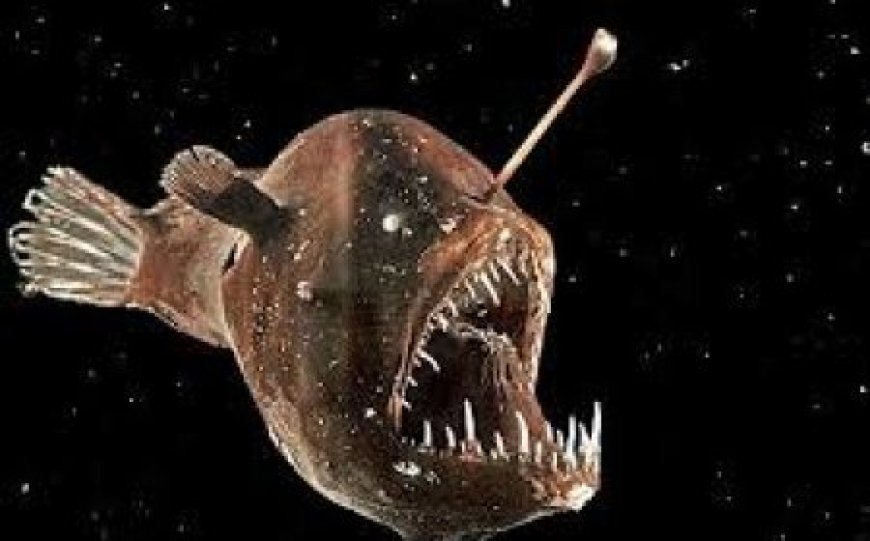
Atlantic football fish Himantolophidae using its bioluminescent lure to attract prey in deep Atlantic waters
Depth in the Canary Islands
Anglerfish in the waters around the Canary Islands are deep-sea species, living at extreme depths well beyond the reach of recreational diving. They are typically found at depths starting from several hundred metres, with many records coming from beyond 1,000 metres in the open Atlantic.
At these depths, light does not penetrate and conditions are completely dark and high pressure, which is why their bioluminescent lure is such an effective adaptation for hunting.
Encounters with anglerfish in this region are rare and usually come from deep-sea trawls or scientific sampling rather than direct observation in the water.
As top-level predators of the deep ocean food web, they feed on smaller mesopelagic fish such as lanternfish, along with cephalopods and crustaceans. In turn, they can be preyed upon by larger deep-diving animals such as sperm whales.
Despite their unusual appearance, they are highly adapted to one of the most extreme environments on the planet and play an important role in deep Atlantic ecosystems.
In Fuerteventura
The Atlantic football fish is a deep-sea species that sits far outside the range of marine life encountered around Fuerteventura’s coastal waters. It remains one of the more unusual inhabitants of the wider Atlantic deep ocean, and is rarely seen outside of scientific sampling. For more examples of the species you are more likely to encounter locally, see the Marine Life in Fuerteventura guide.