Tefía, Fuerteventura: Rural Life and Tradition
Discover Tefía in Fuerteventura, a traditional inland village known for its rural landscape, cultural heritage and peaceful atmosphere.
 Luisa
Luisa

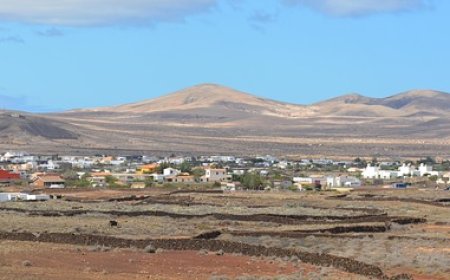
Tefía is a small rural village in the centre of Fuerteventura, offering a glimpse into the island’s traditional way of life away from the main tourist areas.
Getting out and about in Fuerteventura is easy, and places like Tefía are simple to reach, whether by car or public transport. Set within a quiet inland landscape, it is one of the island’s hidden gems, where life moves at a slower pace.
Arriving in Tefía
If you follow the road from La Oliva towards Puerto del Rosario, you will pass Tindaya Mountain and notice a statue standing prominently on your right.
This monument is dedicated to Miguel de Unamuno, an outspoken critic of the military dictatorship who was exiled to the island in March 1924.
You may also notice a small memorial to a fallen airman in this area, a reminder of the island’s aviation history.
Just beyond this point, a turning on the right leads to the village of Tefía and the restored settlement of La Alcogida, also known as the Eco Museum.

La Alcogida - Living Eco Museum
The museum in Tefía is made up of a collection of traditional buildings, including seven different local house designs that show how people once lived on the island.
The name “Alcogida” comes from the system used to collect rainwater, as this area has historically been a natural catchment point.
When visiting Fuerteventura today, you rarely think about where the water comes from, as it simply appears from the tap. In the past, however, it was a very different story.
Local farmers and shepherds relied on regular access to water to sustain both crops and animals, including goats, dogs, donkeys, chickens, doves and camels, all of which were kept in enclosures.
Water was so scarce that it often had to be carried by hand, with water carriers, known as aguadores, playing an important role in daily life across the island.


Farming and traditional agriculture
However, some crops were, and still are, grown without the need for irrigation. Thanks to the farmers’ knowledge and experience, they were able to make use of moisture in the air and ground.
Plants such as cacti, aloe vera and saltwort thrive in these conditions, and were important both for local use and for trade, alongside crops like vegetables, pulses and grain.
Saltwort was also used beyond farming, particularly in traditional lime kilns, where it played a role in local building and industry — something you can explore further in our guide to lime kilns in Fuerteventura.
A close-knit community
When visiting Tefía, you can sense the closeness of this small community and imagine how everyday life once was.
Each house is named after a previous owner and includes displays showing the types of work carried out there, such as basket making, grinding flour for bread, lace making and various forms of animal husbandry.
The simple stone-built houses, many with just a well to store precious rainwater, have been carefully restored, and standing proudly just behind the village is a traditional windmill.
Tefía Windmill
The windmill in Tefía is unique on the island, as it is the only one with six sails. Although it was erected in the 1930s, it was built using traditional methods, and the machinery itself is much older, originally coming from a mill near the cemetery in La Oliva.
This type of windmill is known as a “macho”, or male windmill, and differs from the single-storey frame mills that can be seen along the roadside. These structures were introduced in the 19th century, based on a design by Isidoro Ortega from La Palma, which transformed milling on the island.
Although the original tower was destroyed by fire, it has since been carefully restored. Windmills like this were used to grind cereals into gofio, a staple food in traditional Canarian life.

A close-knit community
When visiting Tefía, you can sense the closeness of this small community and imagine how everyday life once was.
Each house is named after a previous owner and includes displays showing the types of work carried out there, such as basket making, grinding flour for bread, lace making and various forms of animal husbandry.
The simple stone-built houses, many with just a well to store precious rainwater, have been carefully restored, and standing proudly just behind the village is a traditional windmill.
Church of San Agustín
There is a church overlooking Tefía, dedicated to Saint Augustine and completed in 1714 during a period of economic prosperity.
Originally a small chapel, it was expanded as the local population grew. Today, it stands as a distinctive building that is well worth a visit, not only for its architecture but also for the artwork inside.
From its elevated position, there are wide views across La Alcogida Eco Museum and the surrounding landscape, stretching towards the plains of Llano del Muchichafe behind the traditional windmill.

Tefía and the Spanish Civil War
Tefía also has a more complex and lesser-known history. The area was once home to the island’s original airport, as well as a concentration camp during the time of the Spanish Civil War.
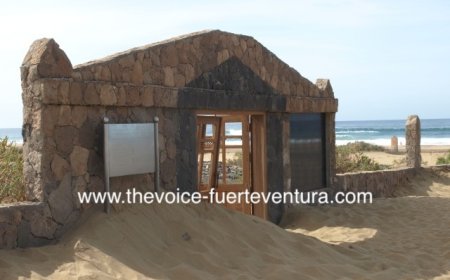
Today, only a former administrative building remains, with little visible trace of what was once here.
However, the history of this area stretches back much further. From the indigenous Mahos, who lived here for centuries and left their mark on the landscape, to the hardships of later rural life, and eventually the arrival of aviation and the impact of war.
It is a place shaped by many layers of history, much of it hidden, but still present in the surrounding landscape.
Visiting Tefía
Visiting Tefía offers a chance to experience a different side of Fuerteventura, where local history adds depth to any stay on the island.
Today, the museum is easy to explore, with information available in several languages, allowing you to wander through and experience what life was once like in this rural setting.
If you return after dark, the nearby observatory offers another unique experience, with clear skies making it an ideal place for stargazing.
Tefía is located close to other inland villages such as Tetir, where you can experience a similarly quiet and traditional side of the island.
An article by local Historian Bernie Power with The Voice Fuerteventura