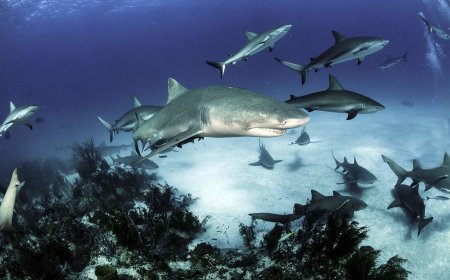
Nudibranch - Hypselodoris
Nudibranch Hypselodoris are colourful sea slugs found in reef habitats around Fuerteventura. Learn about their appearance, behaviour and lifecycle in Canary Islands waters.
 Luisa
Luisa
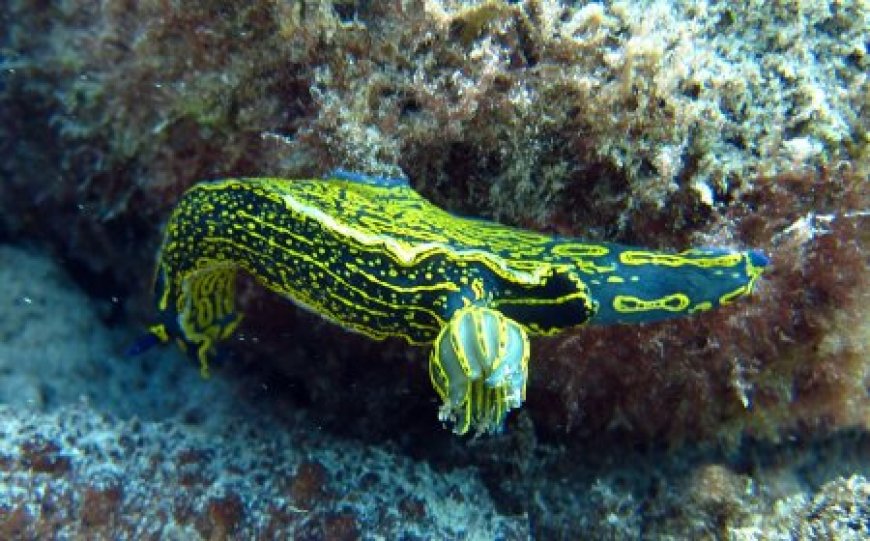
Nudibranchs are a group of small marine sea slugs found in oceans around the world, with several species recorded in the waters surrounding the Canary Islands, including Fuerteventura. Although they are often difficult to spot due to their size and camouflage, they are one of the most colourful and visually striking invertebrates found in the marine environment.
There are thousands of nudibranch species globally, and the waters around the Atlantic and Macaronesian region continue to reveal new or rarely recorded species. In Fuerteventura, sightings are typically associated with rocky reefs, algae-rich areas, and deeper coastal zones where conditions support a diverse range of marine life.
An Article by Hannah Mackay, Local Scuba diving instructor with The Voice Fuerteventura
What they look like
Nudibranchs are soft-bodied marine molluscs that come in an extraordinary range of shapes, colours and patterns. They can appear almost fluorescent, with bright blues, oranges, yellows, purples and contrasting markings that often serve as warning colours in the wild.
The name comes from the Latin nudus, meaning naked, and the Greek brankhia, meaning gills. Nudibranchs are a group of sea slugs that lack a protective shell in their adult form.
Despite their delicate appearance, they are highly adapted to their environment. Many species have external structures called cerata or gills along their bodies, which are visible and used in respiration. Sizes vary widely, from just a few millimetres to several centimetres in length, although some species can grow larger depending on conditions.
Nudibranchs have very limited vision and rely instead on chemical sensing. They use sensory organs called rhinophores, located on the head, which act as scent detectors to help them locate food and detect other nudibranchs in the area. These rhinophores can be retracted into protective folds if the animal feels threatened.
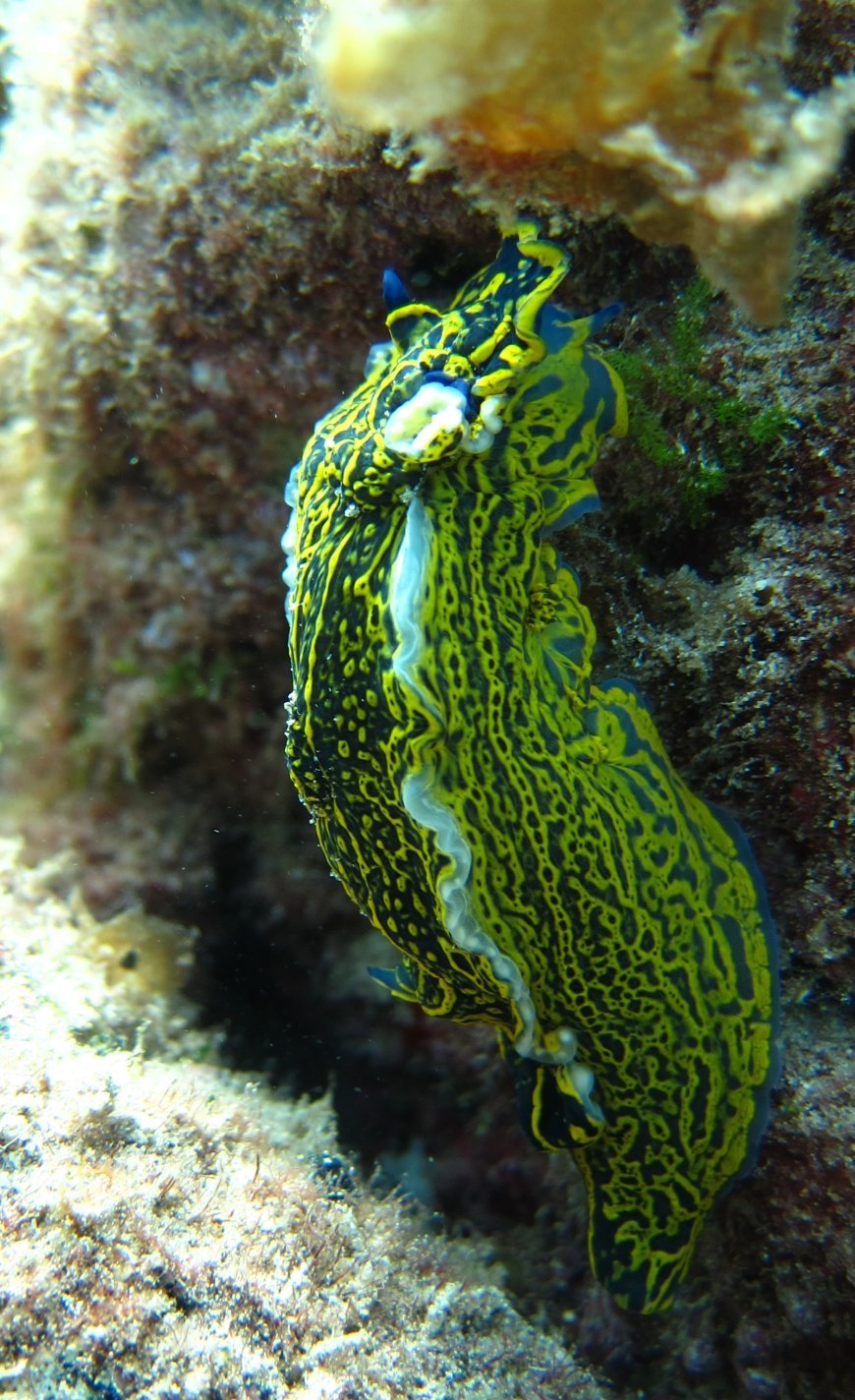
Close up of nudibranch showing rhinophores and external gill structures
Where they live in Fuerteventura
Nudibranchs are found in a variety of marine habitats around Fuerteventura, particularly in rocky reef systems and areas with sponge, hydroid or algae growth. These environments provide both food sources and camouflage.
They are most commonly seen by divers rather than snorkellers due to their size and preference for slightly deeper or more sheltered reef areas. Many species remain close to the seabed or hidden within crevices, making them easy to overlook unless conditions are ideal.
Their presence is often an indicator of healthy marine ecosystems, as they are sensitive to changes in water quality and habitat structure.
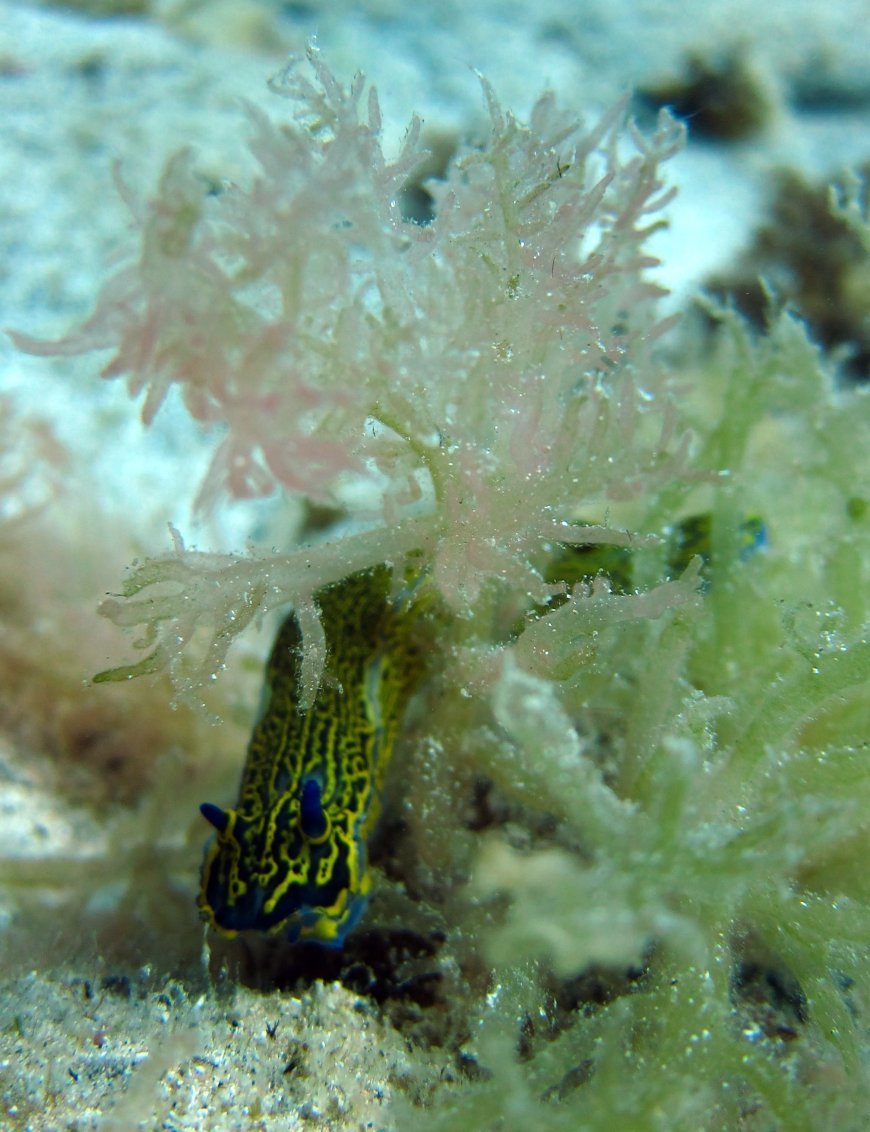
Nudibranch found on rocky reef substrate in coastal waters of Fuerteventura
Behaviour and feeding
Nudibranchs are slow-moving and mostly solitary creatures. They crawl along surfaces using a muscular foot, feeding on a variety of marine organisms depending on the species, including sponges, hydroids, algae and sometimes even other small invertebrates.
Many species have developed chemical defence systems by storing toxins from their food sources, making them unappealing or even harmful to predators. Their bright colouring often acts as a warning signal rather than camouflage.
They also have limited eyesight and rely heavily on chemical sensing to navigate their environment, locate food and detect other nudibranchs.
Reproduction and lifecycle
Nudibranchs begin life with a small larval stage, during which they possess a temporary shell. This shell is lost as they develop into adults, leaving them fully exposed and reliant on other defence strategies.
To compensate for the lack of a shell, nudibranchs have developed a range of survival adaptations. Some species are able to store toxins from their food sources or produce chemical defences of their own, making them unpalatable to predators. Others rely on camouflage, blending into their surroundings to avoid detection.
Nudibranchs are hermaphrodites, meaning each individual carries both male and female reproductive organs. During reproduction, they exchange genetic material with a partner before laying eggs in distinctive spiral or ribbon-like formations.
These eggs hatch into free-swimming larvae, which drift within the plankton before settling on the seabed and developing into adult forms. Their lifespan is generally short, ranging from a few weeks up to around a year depending on species and conditions.
Movement is achieved using a broad muscular foot, which allows them to glide slowly across surfaces while searching for food.
In Fuerteventura
Nudibranchs are present in the waters around Fuerteventura but are not commonly seen without careful observation or diving experience. They are most likely to be encountered in rocky reef areas, particularly where there is rich invertebrate life.
For divers, they are considered one of the most rewarding marine finds due to their colour, diversity and rarity of sightings. Each discovery is often unique, as different species may appear depending on depth, season and habitat conditions.
Nudibranchs form part of the broader and highly diverse marine ecosystem around Fuerteventura. While they are not among the most frequently seen species, they represent the hidden diversity of reef life in the Canary Islands. More common marine species found in the region can be explored in the Marine Life in Fuerteventura guide.