Brittle Starfish - Ophiuroidea
Brittle starfish Ophiuroidea are fast moving marine invertebrates found around Fuerteventura. Learn about their flexible arms, behaviour and role in reef ecosystems.
 Luisa
Luisa

Brittle starfish are fascinating marine invertebrates found in oceans around the world, including the waters around Fuerteventura. Although they are closely related to starfish, they differ in both appearance and movement, with long, flexible arms and a small central body.
They are often hidden from view, spending much of their time tucked away in crevices, under rocks, or within reef structures.
An Article by Hannan Mackay, local Scuba instructor with The Voice Fuerteventura
What they look like
Brittle starfish have a small, rounded central disc with five long, slender arms that extend outward. These arms are highly flexible and can reach lengths of up to 60 cm in some species.
Their arms are clearly distinct from the central body, unlike true starfish, and have a whip-like, almost snake-like appearance. Colours vary widely depending on species, ranging from browns and reds to lighter tones that help them blend into their surroundings.
The central disc contains the main internal organs, including digestion and reproduction. On the underside is the mouth, which serves both to ingest food and expel waste.
Their structure gives them a graceful, almost serpentine look when moving across the seabed.
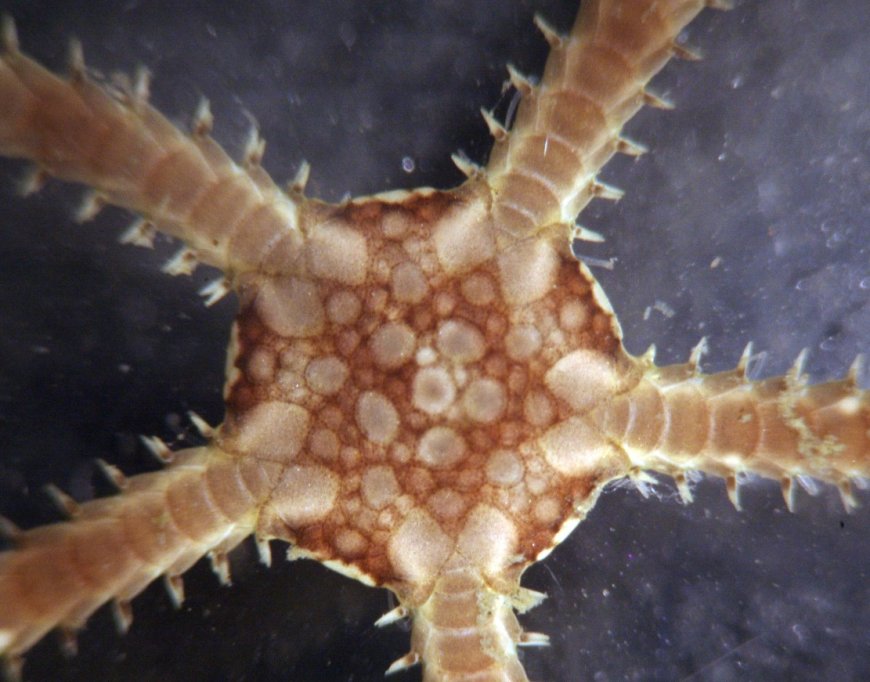
Close up of brittle starfish highlighting central body and whip like arms
Where they live in Fuerteventura
Brittle starfish are typically found in rocky reefs, crevices, and sandy seabeds where they can remain hidden during the day. Around Fuerteventura, they are most commonly associated with reef environments, often sheltering beneath rocks, sponges or alongside sea urchins.
They are rarely seen out in the open and are often only noticed when moving between hiding places or when disturbed.
Globally, they are widespread and can be found in a wide range of marine habitats, from shallow coastal waters to deep ocean environments.
Movement and behaviour
Brittle starfish move by actively wriggling their arms in a coordinated motion. One arm typically leads while the others follow in a rowing-like movement, allowing them to move surprisingly quickly across the seabed.
Their arms are connected to the central body in a way that allows a high degree of flexibility, similar to a ball-and-socket joint. This gives them a fluid, almost serpent-like movement and allows them to squeeze into tight spaces with ease. To change direction, they simply select a new leading arm which takes over movement.
Feeding
Brittle starfish are opportunistic feeders. They consume a mixture of organic material, including algae, detritus and small marine animals such as crustaceans.
They often feed by extending their arms into the water or across the seabed, capturing particles that float by or scavenging for food.
Their feeding behaviour makes them an important part of the marine ecosystem, helping recycle organic matter on the ocean floor.
They are omnivorous and feed on a combination of algae, detritus and small marine organisms. Much of their feeding involves scavenging organic material from the seabed.
Defence and survival
One of the most distinctive features of brittle starfish is their ability to shed an arm when threatened. This process, known as autotomy, allows them to escape predators.
The lost arm does gradually regenerate over time, which allows the animal to fully recover.
This ability, combined with their camouflage and nocturnal behaviour, helps them avoid predation.
In Fuerteventura
Brittle starfish are present in the waters around Fuerteventura but are often overlooked due to their secretive nature. They are most likely to be encountered in rocky reef areas or when exploring crevices and sheltered habitats.
For divers and snorkellers, spotting one can be a rewarding experience, particularly when observing their distinctive movement across the seabed.
Brittle starfish are part of the wider group of echinoderms found in the Canary Islands, alongside species such as sea urchins and starfish. They contribute to the balance of reef ecosystems and are one of many fascinating invertebrates that can be discovered in the Marine Life in Fuerteventura guide.